

Boston Area Retail Market Report — Q2 2026
Overview
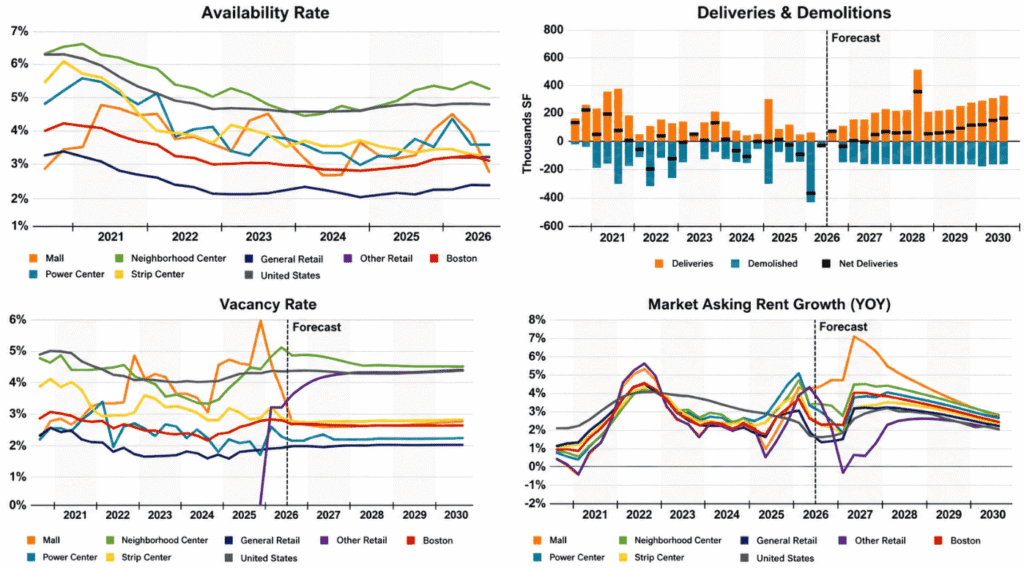
Boston’s retail market remains strong, supported by a solid consumer base, steady employment, rising household incomes, and a limited construction pipeline. Consumer spending continues to grow despite higher costs for food, energy, and transportation, helping attract both national and international retailers.
Retail space remains difficult to find, with availability at just 3.1%, well below the national average of 4.8%. Demand has slowed slightly but remains healthy, particularly for grocery stores and experiential retailers such as pickleball and indoor golf facilities.
New retail development remains limited, with only 640,000 square feet under construction, representing 0.3% of total inventory. At the same time, older retail properties continue to be demolished or removed, reducing supply and improving the overall quality of the market.
Although net absorption has been negative and vacancy has risen slightly over the past year, Boston’s 2.6% vacancy rate remains among the lowest in the country. Vacancies are expected to stay below 3% through the remainder of the year.
Strong market fundamentals continue to support rent growth, with asking rents increasing 2.5% year over year, above the national average. However, slower job growth, tariffs, inflation, and slower population growth could reduce consumer spending and delay future retail expansion if economic conditions weaken.
Information provided by CoStar.com